C10 – Cavetto Cornice
£40.00 Inc VAT
Simple cavetto plaster cornice with smooth curved lines and timeless styling. Handmade in Birmingham using traditional fibrous plaster methods.

Showing 1–16 of 143 results


Simple cavetto plaster cornice with smooth curved lines and timeless styling. Handmade in Birmingham using traditional fibrous plaster methods.


Classic plaster coving with smooth curves and clean traditional detailing. Handmade in Birmingham using traditional fibrous plaster methods.


Elegant Georgian plaster cornice with smooth curves and classic traditional styling. Handmade in Birmingham using fibrous plaster methods.


Traditional plaster cornice with elegant bead detailing and classic curved styling. Handmade in Birmingham using fibrous plaster methods.


Decorative plaster cornice with elegant acanthus leaf detailing and classical styling. Handmade in Birmingham using fibrous plaster methods.


Traditional ogee plaster cornice with smooth curves and timeless styling. Handmade in Birmingham using fibrous plaster methods.


Decorative plaster cornice with bold acanthus leaf detailing and elegant classical styling. Handmade in Birmingham using fibrous plaster methods.


Decorative Greek key plaster cornice with bold geometric detailing and classical styling. Handmade in Birmingham using fibrous plaster methods.


Traditional plaster cornice with elegant egg and dart detailing and classical styling. Handmade in Birmingham using fibrous plaster methods.

Traditional Victorian plaster cornice with bold dentil detailing and elegant classical styling. Handmade in Birmingham using fibrous plaster methods.


Elegant traditional plaster cornice with layered mouldings and smooth classical detailing. Handmade in Birmingham using traditional fibrous plaster methods.


Elegant Georgian-style plaster cornice with layered detailing and smooth classical curves. Handmade in Birmingham using traditional fibrous plaster methods.


Cavetto plaster cornice with a deep concave profile. Handmade in the UK, ideal for larger rooms and both modern and traditional interiors.


Elegant Georgian step plaster cornice with crisp linear detailing and a soft curved profile. Handmade in Birmingham using traditional fibrous plaster methods.


Traditional egg and dart plaster cornice with a smooth curved profile and classical detailing. Handmade in Birmingham using traditional fibrous plaster techniques.


Elegant Georgian plaster cornice with smooth curves and stepped detailing. Handmade in Birmingham using traditional fibrous plaster methods.
Georgian cornice draws directly on Greek and Roman architecture. It’s usually more restrained than Victorian work, with ornament used sparingly and in careful proportion.
Look out for dentils, small rectangular blocks set in a row (C54, C55 and C152), the softly rounded lamb’s tongue moulding (C61), and richer enriched hall cornice for the most important rooms (C171 and C172).
Late Georgian and Regency houses, from around 1811 to 1837, often have slightly lighter, more decorative cornice. Ask us if you’re matching a Regency property.
For a lighter option, lightweight Orac profiles with egg and dart (C212), dentil (C211) and acanthus (C201) detail suit Georgian rooms, alongside classic ogee and cove shapes.
Coving and cornice in the classical style used in British homes from about 1714 to 1837, typically with restrained detail such as dentils and lamb’s tongue mouldings.
For listed properties it’s usually best to match the original exactly. We can reproduce a surviving profile, and we regularly work on listed and heritage buildings. See restoration and matching.
Yes. Use the “Order Sample” button on any product page.

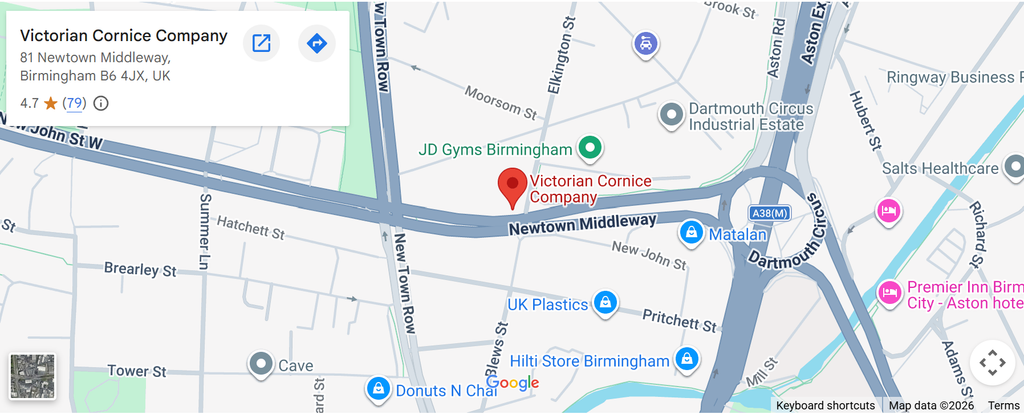
81 Newtown Middleway
Birmingham
B6 4JX
Call: 0121 359 0143
Email: info@victoriancornice.co.uk
© 2026 Victorian Cornice Company Limited
Registered address: 8 Bridge Street, Polesworth, Tamworth, Warwickshire, England, B78 1DT
VAT Registration Number: 812104388
We use essential cookies to keep our website working. With your permission, we’d also like to use analytics and marketing cookies to understand how visitors use our website, measure advertising and help us improve it.