C1 – Victorian Grape & Vine Dentil Cornice
£140.00 Inc VAT
Large decorative plaster cornice featuring traditional grape and vine detailing with dentil blocks. Handmade in Birmingham using traditional fibrous plaster methods.

Explore our Victorian Cornice & Coving collection, featuring traditional handmade plaster profiles, elegant swan neck designs and richly decorative cornice for period and modern homes.
Explore Victorian cornice and coving, from traditional swan neck profiles to ornate plaster designs.
Showing 1–16 of 166 results


Large decorative plaster cornice featuring traditional grape and vine detailing with dentil blocks. Handmade in Birmingham using traditional fibrous plaster methods.


Traditional swan neck plaster cornice with elegant Victorian styling and smooth flowing curves. Handmade in Birmingham using fibrous plaster methods.


Large Victorian ogee plaster cornice with deep curves and strong stepped detailing. Handmade in Birmingham using traditional fibrous plaster methods.


Traditional Victorian swan neck plaster cornice with elegant curves and layered detailing. Handmade in Birmingham using fibrous plaster methods.


Compact Victorian swan neck plaster cornice with elegant curves and traditional detailing. Handmade in Birmingham using fibrous plaster methods.


Highly decorative Victorian plaster cornice with pierced detailing and ornate floral enrichment. Handmade in Birmingham using traditional fibrous plaster methods.


Simple cavetto plaster cornice with smooth curved lines and timeless styling. Handmade in Birmingham using traditional fibrous plaster methods.


Classic plaster coving with smooth curves and clean traditional detailing. Handmade in Birmingham using traditional fibrous plaster methods.


Traditional plaster cornice with elegant bead detailing and classic curved styling. Handmade in Birmingham using fibrous plaster methods.


Decorative plaster cornice with elegant acanthus leaf detailing and classical styling. Handmade in Birmingham using fibrous plaster methods.


Traditional ogee plaster cornice with smooth curves and timeless styling. Handmade in Birmingham using fibrous plaster methods.


Decorative plaster cornice with bold acanthus leaf detailing and elegant classical styling. Handmade in Birmingham using fibrous plaster methods.


Decorative Greek key plaster cornice with bold geometric detailing and classical styling. Handmade in Birmingham using fibrous plaster methods.


Traditional plaster cornice with elegant egg and dart detailing and classical styling. Handmade in Birmingham using fibrous plaster methods.

Traditional Victorian plaster cornice with bold dentil detailing and elegant classical styling. Handmade in Birmingham using fibrous plaster methods.


Elegant traditional plaster cornice with layered mouldings and smooth classical detailing. Handmade in Birmingham using traditional fibrous plaster methods.
Victorian cornice and coving is renowned for its decorative detail, substantial proportions and variety of architectural styles. During the Victorian period (1837–1901), ornamental plasterwork became an important feature of domestic interiors, reflecting influences ranging from classical architecture to Gothic Revival and more elaborate decorative traditions.
Victorian homes often featured cornice designed to emphasise the transition between walls and ceilings. In grand reception rooms and entrance halls, deeper mouldings incorporating dentils, floral ornamentation and classical enrichment created an impressive architectural finish. Simpler curved and stepped profiles were commonly used in bedrooms and smaller rooms.
At Victorian Cornice Company, we supply traditional Victorian-style cornice and coving suitable for period property restoration, heritage projects and contemporary interiors seeking timeless architectural character.
Our collection includes handmade plaster cornice produced in Birmingham, alongside selected lightweight alternatives.
Victorian decorative plasterwork encompasses a wide variety of profiles, ranging from understated curved mouldings to highly ornate architectural designs.
Some of the traditional styles in our collection include:
Swan neck cornice became particularly characteristic of many Victorian interiors, while dentil, Egg & Dart and floral motifs continued the tradition of classical decorative plasterwork.
The appropriate style depends on the age and proportions of the property, the ceiling height and any surviving original plasterwork.
Swan neck cornice is recognised by its pronounced flowing curve, which creates a graceful transition between the wall and ceiling. These profiles are particularly suitable for Victorian properties and traditional interiors seeking a strong but elegant architectural finish.
Ogee cornice features a characteristic curved profile combining concave and convex forms. Ogee mouldings can provide a more restrained finish while retaining traditional Victorian character.
Dentil cornice incorporates a repeating series of small rectangular blocks inspired by classical architecture. This creates a structured decorative effect particularly suited to formal interiors.
Ornate Victorian cornice can incorporate floral ornamentation, acanthus leaves, Egg & Dart motifs, enriched mouldings and deeply modelled decorative features. These elaborate profiles are often most appropriate for substantial reception rooms and properties with higher ceilings.
Traditional fibrous plaster cornice remains an excellent choice for Victorian property restoration, particularly where authentic materials, sharp decorative detailing and sympathetic architectural finishes are important.
Our handmade plaster cornice is manufactured in our Birmingham workshop using established fibrous plaster techniques. These traditional methods allow us to produce detailed decorative mouldings, deep profiles and classical architectural features suitable for both restoration and new interior projects.
We also supply lightweight cornice and coving, including selected traditional profiles from Orac Decor. Lightweight alternatives can provide practical benefits where reduced weight or ease of installation is preferred.
Certain lightweight ranges also include flexible versions suitable for curved walls and bay windows, subject to the individual product’s specifications.
When selecting Victorian cornice, consider the ceiling height, room proportions and existing architectural details.
Smaller rooms, bedrooms and hallways may benefit from simpler swan neck or ogee profiles that provide traditional character without dominating the room.
Larger drawing rooms, dining rooms and entrance halls can accommodate deeper cornice designs featuring dentils, floral enrichment and more substantial decorative mouldings.
Victorian properties often used different levels of decoration throughout the building. Principal reception rooms might feature elaborate plaster cornice, while bedrooms and secondary rooms typically incorporated more restrained profiles.
When replacing damaged or missing cornice in an original Victorian property, matching the surviving plasterwork is often preferable to selecting a new design based solely on the period.
Our team can help identify suitable profiles from photographs, measurements or surviving sections of cornice. Where an exact match is unavailable, we can discuss bespoke plaster reproduction.
Samples are available for suitable products, allowing you to assess the size, shape and detailing before ordering.
Original Victorian plasterwork is an important part of a period property’s architectural character.
Where sections have been damaged or removed, sympathetic repair or reproduction can help preserve the original appearance of the room.
Victorian Cornice Company provides bespoke decorative plasterwork services, including the reproduction of traditional cornice profiles from surviving sections or suitable reference material. Our team can discuss plaster restoration and matching for your property.
For listed buildings and heritage properties, the appropriate conservation approach and any necessary permissions should be established before altering historic plasterwork.
Victorian Cornice Company specialises in the manufacture, supply and installation of traditional decorative plasterwork.
Our skilled craftsmen produce plaster cornice in our Birmingham workshop using established fibrous plaster techniques, combining traditional craftsmanship with modern manufacturing requirements.
We supply customers throughout the UK and offer a professional installation service for residential properties, commercial interiors and heritage restoration projects.
Whether you’re restoring a Victorian townhouse, renovating a period property or introducing traditional detailing into a modern home, our team can help you select a cornice profile that complements your interior.
Victorian cornice and coving refers to decorative mouldings inspired by the architectural styles popular during the Victorian period (1837–1901). Traditional designs include swan neck and ogee profiles, dentil cornice, Egg & Dart ornamentation and more elaborate floral detailing. Victorian cornice ranges from simple curved mouldings to substantial decorative profiles used in grand reception rooms.
Victorian swan neck coving features a distinctive flowing curve that creates a pronounced transition between the wall and ceiling. The design became a common feature of Victorian interiors and is available in different sizes, from compact profiles suitable for smaller rooms to deeper cornice for properties with higher ceilings.
Rooms with higher ceilings can accommodate deeper cornice profiles with greater projection and decorative detailing. Traditional dentil cornice, grand swan neck profiles and ornate Victorian plaster mouldings can all work well. Compare each product’s drop and projection to find a design proportionate to your room.
Yes. Victorian Cornice Company can assist with identifying and reproducing traditional plaster cornice where sections are damaged or missing. Photographs, measurements or a surviving section of original plasterwork can help establish the correct profile. Where necessary, bespoke moulds can be produced to reproduce the existing design.
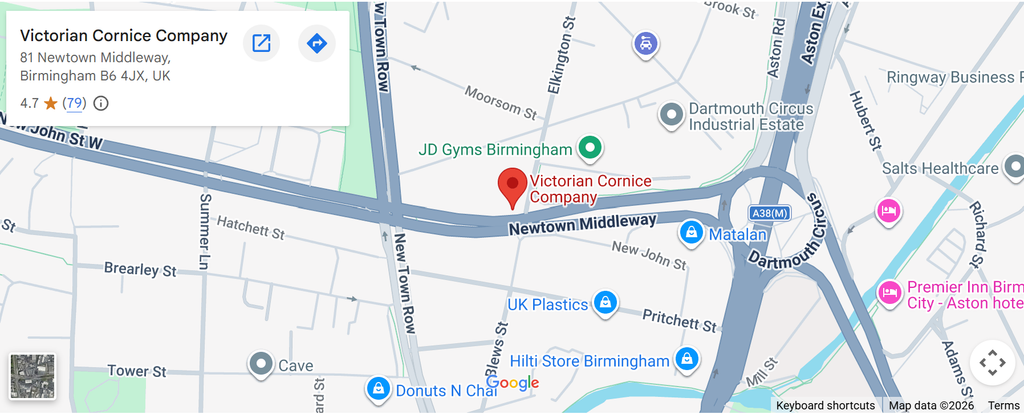
81 Newtown Middleway
Birmingham
B6 4JX
Call: 0121 359 0143
Email: info@victoriancornice.co.uk
© 2026 Victorian Cornice Company Limited
Registered address: 8 Bridge Street, Polesworth, Tamworth, Warwickshire, England, B78 1DT
VAT Registration Number: 812104388
We use essential cookies to keep our website working. With your permission, we’d also like to use analytics and marketing cookies to understand how visitors use our website, measure advertising and help us improve it.