C1 – Victorian Grape & Vine Dentil Cornice
£140.00 Inc VAT
Large decorative plaster cornice featuring traditional grape and vine detailing with dentil blocks. Handmade in Birmingham using traditional fibrous plaster methods.

Showing 1–16 of 143 results


Large decorative plaster cornice featuring traditional grape and vine detailing with dentil blocks. Handmade in Birmingham using traditional fibrous plaster methods.


Classic stepped plaster cornice with clean Edwardian styling and balanced proportions. Handmade in Birmingham using traditional fibrous plaster methods.


Traditional ogee plaster cornice with clean Edwardian styling and stepped detailing. Handmade in Birmingham using traditional fibrous plaster methods.


Traditional swan neck plaster cornice with elegant Victorian styling and smooth flowing curves. Handmade in Birmingham using fibrous plaster methods.


Traditional Edwardian plaster cornice with smooth flowing curves and clean detailing. Handmade in Birmingham using fibrous plaster methods.


Large Victorian ogee plaster cornice with deep curves and strong stepped detailing. Handmade in Birmingham using traditional fibrous plaster methods.


Traditional Victorian swan neck plaster cornice with elegant curves and layered detailing. Handmade in Birmingham using fibrous plaster methods.


Compact Victorian swan neck plaster cornice with elegant curves and traditional detailing. Handmade in Birmingham using fibrous plaster methods.


Highly decorative Victorian plaster cornice with pierced detailing and ornate floral enrichment. Handmade in Birmingham using traditional fibrous plaster methods.


Simple cavetto plaster cornice with smooth curved lines and timeless styling. Handmade in Birmingham using traditional fibrous plaster methods.


Modern stepped plaster cornice with clean geometric lines and minimalist styling. Handmade in Birmingham using traditional fibrous plaster methods.


Classic plaster coving with smooth curves and clean traditional detailing. Handmade in Birmingham using traditional fibrous plaster methods.


Elegant Georgian plaster cornice with smooth curves and classic traditional styling. Handmade in Birmingham using fibrous plaster methods.


Traditional plaster cornice with elegant bead detailing and classic curved styling. Handmade in Birmingham using fibrous plaster methods.


Decorative plaster cornice with elegant acanthus leaf detailing and classical styling. Handmade in Birmingham using fibrous plaster methods.


Traditional ogee plaster cornice with smooth curves and timeless styling. Handmade in Birmingham using fibrous plaster methods.
Victorian Cornice Company has been manufacturing traditional fibrous plaster cornice in Birmingham since 1986. Every profile in our plaster range is made to order in our workshop by skilled craftsmen using traditional plaster casting techniques.
Unlike mass-produced lightweight mouldings, genuine plaster cornice has the depth, weight and crisp architectural detail associated with original period plasterwork. It is equally at home in a Victorian or Georgian property as it is in a modern interior where a substantial, high-quality finish is required.
With more than 140 plaster cornice and coving profiles available, our collection ranges from simple plain mouldings and classic swan neck designs to dentil, egg and dart and highly decorative period cornices. We can also reproduce existing mouldings where an original cornice needs to be matched, repaired or reinstated.
Choosing the right plaster cornice is about more than simply finding a design you like. The size and proportions of the room, ceiling height and position of windows and doors all affect how a cornice will look once installed.
Larger rooms and higher ceilings can usually accommodate deeper, more substantial profiles, while smaller rooms or standard ceiling heights often suit a more restrained design. The projection is how far the cornice extends across the ceiling, while the drop is how far it extends down the wall.
It is particularly important to measure the distance between the ceiling and the top of your windows, as this can limit the maximum drop of cornice that can be fitted. Bay windows, chimney breasts, fitted wardrobes, picture rails and existing plasterwork should also be taken into account.
If you’re unsure which profile will suit your room, send us photographs, your ceiling height and key measurements and we’ll be happy to recommend suitable options from our range.
Traditional fibrous plaster remains an excellent choice where authenticity, architectural detail and a substantial finish are important. Its weight and depth allow for sharper profiles, deeper curves and fine decorative details that are particularly well suited to period properties and high-quality interior schemes.
One of the major advantages of plaster is its versatility. It can be used for everything from simple contemporary profiles to highly decorative cornices incorporating dentils, egg and dart, floral enrichments and other traditional details.
Plaster cornice can also be repaired, reproduced and matched to existing mouldings. If an original section has been damaged or removed, we can often create a mould from the surviving plasterwork and manufacture new sections to match. Where nothing suitable exists within our standard range, we can also manufacture completely bespoke cornice for individual projects.
Different architectural periods developed their own characteristic styles of decorative plasterwork, although there was always variation between individual properties.
Victorian cornice often features deeper profiles, swan neck curves, ogee shapes and more decorative detailing. Larger reception rooms and properties with higher ceilings can often accommodate the more substantial proportions commonly associated with Victorian interiors.
Georgian cornice tends to follow more classical proportions, with details such as dentils, egg and dart, beads and restrained decorative elements. Symmetry and proportion are particularly important when choosing cornice for a Georgian-style interior.
Edwardian cornice is often cleaner and slightly more restrained, with elegant curves, stepped profiles and simpler decorative detailing. These designs work well in period properties but can also suit traditional interiors where a less ornate finish is preferred.
These are useful guidelines rather than strict rules. Where original plasterwork survives elsewhere in the property, we would normally recommend using those existing details as the best guide when selecting or reproducing a suitable cornice.
If you have original plaster cornice that is damaged, incomplete or missing in places, we can often reproduce it rather than replacing everything with a different design.
Our team can create moulds from suitable existing sections and manufacture new plaster cornice to closely match the original profile. This is particularly useful when extending into an existing room, altering chimney breasts, reinstating period features or repairing damage caused by building work or water ingress.
We also carry out specialist restoration work where original decorative plasterwork can be repaired and retained. Where no suitable standard profile exists, we can manufacture completely bespoke cornice and mouldings for individual residential, heritage and commercial projects.
For period and listed properties, retaining and matching original plasterwork is usually preferable to unnecessary replacement wherever this is practical.
Traditional plaster cornice is heavier than lightweight coving and needs to be fitted correctly to achieve a clean, secure and continuous finish.
Our experienced installation teams fit fibrous plaster cornice throughout the UK for homeowners, builders, architects, interior designers and commercial contractors. Each length is carefully measured, cut and fixed on site, with internal and external corners, joints and junctions formed and finished by hand.
This is particularly important in older properties, where walls are rarely perfectly straight and ceilings are not always level. Bay windows, chimney breasts and other architectural features can also make installation more complex than it first appears.
We offer both supply-only and full supply-and-installation services, from individual rooms through to complete property renovations, heritage projects and larger commercial developments.
Because traditional plaster cornice is fragile by nature, we hand-deliver our plaster products throughout the UK rather than sending them through a standard parcel courier network.
This allows the cornice to be handled correctly from our Birmingham workshop through to delivery. Delivery charges are based on distance and are calculated according to the location of your project.
As our plaster cornice is handmade to order, lead times can vary depending on the profile, quantity and complexity of the order. If you are working towards a particular installation or decorating date, please contact us before ordering and we can advise on current manufacturing timescales.
Fibrous plaster cornice is manufactured using gypsum plaster and water, so newly made cornice can still contain some moisture when it is delivered.
This is completely normal and does not mean there is anything wrong with the product. In fact, our installation teams often prefer fitting plaster cornice while it still retains some moisture, as it can be easier to work with when forming joints, filling and carrying out the final making-good.
The important stage is before decoration. Once the cornice has been installed, it should be allowed to dry thoroughly before paint or other finishes are applied.
If you specifically require your plaster cornice to be fully dried before delivery, please let us know when ordering so this can be taken into account within the manufacturing schedule.
Start by measuring the complete perimeter of the room, including chimney breasts, bay windows and any other changes in direction.
As a general guide, we recommend allowing approximately 10% extra above the measured perimeter to cover cutting, mitres and normal installation wastage. Rooms with numerous corners, awkward angles or more complicated architectural features may require a little more.
Because our plaster cornice is handmade to order, it is worth checking your measurements carefully before placing the order. If you’re unsure, send us a simple room sketch with the dimensions and we can help calculate the quantity required.
Plaster cornice can be installed around bay windows, chimney breasts and other changes in direction by carefully forming the required mitres on site.
Curved walls are different. Standard straight lengths cannot simply be bent around a substantial curve, so where required we can manufacture bespoke curved plaster cornice sections to suit the radius of the wall.
This allows the cornice profile to continue smoothly around curved architectural features while maintaining the same proportions and detailing as the straight sections.
If your project includes a curved wall, unusual bay or other non-standard detail, please contact us before ordering so we can advise on the best approach.

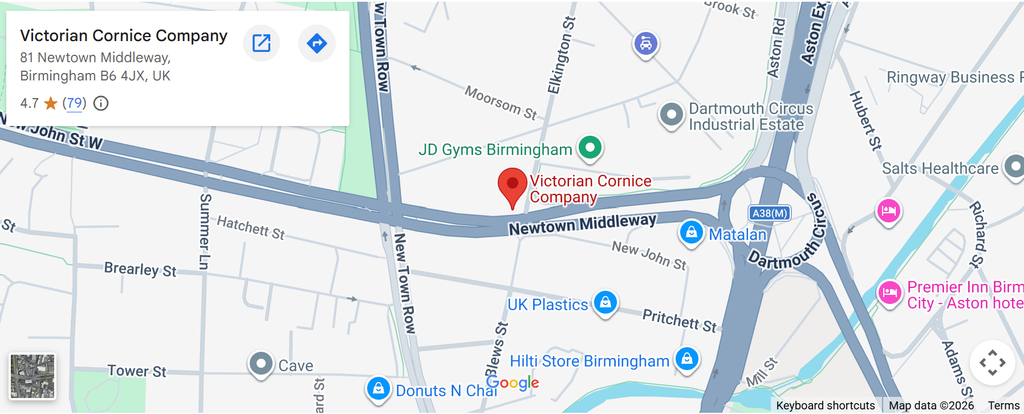
81 Newtown Middleway
Birmingham
B6 4JX
Call: 0121 359 0143
Email: info@victoriancornice.co.uk
© 2026 Victorian Cornice Company Limited
Registered address: 8 Bridge Street, Polesworth, Tamworth, Warwickshire, England, B78 1DT
VAT Registration Number: 812104388
We use essential cookies to keep our website working. With your permission, we’d also like to use analytics and marketing cookies to understand how visitors use our website, measure advertising and help us improve it.