Lightweight Coving vs Traditional Plaster Cornice: Which Is Best for Your Home?
Choosing the right coving or cornice can completely change the appearance of a room. It creates a clean transition between the walls and ceiling, adds architectural character and can help complement the age and style of the property.
The two main options are traditional plaster cornice and lightweight coving. Both have their advantages, but the best choice will depend on the finish you want, your budget, the property itself and whether you intend to install it yourself.

What Is Traditional Plaster Cornice?
Traditional plaster cornice is handcrafted using fibrous plaster techniques that have been used for generations. Quality plaster cornice is typically manufactured using gypsum plaster and reinforced with materials such as timber laths and hessian or jute scrim.
This traditional manufacturing process produces crisp detail, strong definition and an authentic appearance that is difficult to replicate using lightweight materials.
Plaster cornice is particularly well suited to:
- Victorian, Edwardian and Georgian properties
- Period property renovations
- Listed buildings and restoration projects
- Rooms with high ceilings
- Large or highly decorative cornice profiles
- Bespoke designs and matching existing mouldings
Advantages of Traditional Plaster Cornice
One of the greatest advantages of plaster cornice is its appearance. The weight and density of the material allow fine details, deep undercuts and decorative features to be reproduced accurately.
Plaster cornice can also be made to suit a particular room or design. Existing mouldings can be matched, damaged sections can be reproduced and entirely bespoke profiles can be manufactured to an architect’s or interior designer’s specification.
When manufactured and installed correctly, plaster cornice is extremely durable and can remain in place for many decades. It can also be repaired rather than completely replaced if it becomes damaged.
Things to Consider
Traditional plaster cornice is heavier than lightweight coving and generally requires professional installation, particularly when working with large or detailed profiles.
Lengths must be handled carefully, accurately cut and securely fixed. Joints and mitres are then filled and finished by hand to create a seamless result.
Plaster cornice can therefore cost more to install, but it remains the preferred choice where authenticity, craftsmanship and longevity are the main priorities.

What Is Lightweight Coving?
Lightweight coving is manufactured using modern materials such as Duropolymer® and Purotouch®. These products are considerably lighter than traditional plaster and are available in a wide selection of plain, contemporary and decorative designs.
Lightweight coving is particularly suitable for:
- Modern homes and new-build properties
- Renovation projects with limited installation time
- DIY installation
- Bathrooms and other humid areas
- LED lighting coving
- Curved walls when flexible profiles are available
Advantages of Lightweight Coving
The main advantage of lightweight coving is that it is easier to handle and install. Many profiles can be fitted using the correct adhesive without the additional mechanical fixings that may be required for heavy plaster cornice.
This can make lightweight coving a practical choice for DIY projects and installations where speed and convenience are important.
Modern lightweight mouldings are also available in moisture-resistant materials, making them suitable for kitchens and bathrooms. Certain profiles can incorporate concealed LED lighting, while flexible versions can be used around curved walls and rounded features.
Many premium lightweight products provide excellent detail and durability, so they should not be confused with basic polystyrene coving commonly found in DIY stores.
Things to Consider
Although lightweight coving can provide an excellent finish, it does not always have the same depth, weight or authentic appearance as traditional fibrous plaster.
The range is also limited to existing manufactured profiles. While flexible and decorative options are available, lightweight coving cannot usually be customised or replicated in the same way as handmade plaster cornice.
The product itself may not always be cheaper than plaster, particularly when choosing premium profiles. However, the easier installation can reduce fitting time and labour costs.
Traditional Plaster Cornice vs Lightweight Coving
| Feature | Traditional Plaster Cornice | Lightweight Coving |
|---|---|---|
| Appearance | Authentic, crisp and highly detailed | Clean and consistent |
| Weight | Heavy | Lightweight |
| Installation | Professional fitting recommended | Suitable for professional or DIY installation |
| Bespoke options | Can be made, matched or replicated | Limited to available profiles |
| Period properties | Particularly suitable | Suitable for simpler renovations |
| Modern properties | Suitable | Particularly suitable |
| Repairs | Can often be repaired in place | Damaged sections may need replacing |
| Bathrooms | Possible with suitable preparation | Moisture-resistant profiles available |
| Lighting profiles | Bespoke options possible | Wide range of ready-made LED profiles |
| Curved walls | Bespoke curved sections can be manufactured | Flexible versions available for selected profiles |
Which Option Is Right for Your Property?
Choose traditional plaster cornice when you want an authentic period finish, a large decorative profile or a design that must match existing plasterwork. It is also the strongest option for bespoke projects where standard mouldings are not suitable.
Choose lightweight coving when ease of installation, modern design or reduced fitting time is more important. It is an excellent option for new-build properties, contemporary interiors, bathrooms and LED lighting features.
There is no single product that is right for every property. A simple lightweight profile can look perfectly suited to a modern room, while a handmade plaster cornice will usually provide a more appropriate and convincing finish in a period interior.
Speak to Our Cornice Specialists
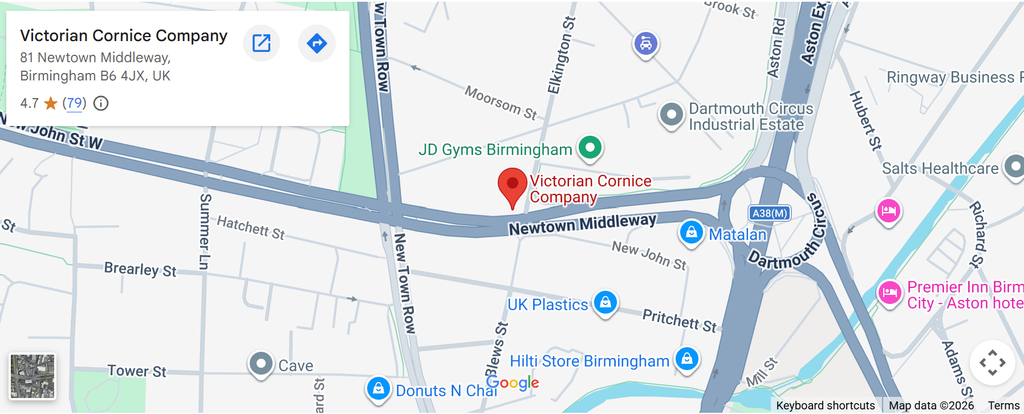
At Victorian Cornice Company, we manufacture traditional fibrous plaster cornice and bespoke mouldings in our Birmingham workshop using established methods and skilled craftsmanship.
We can also supply and install a wide range of premium lightweight coving, including plain, decorative, flexible and lighting profiles.
Whether you are restoring a period property, completing a modern renovation or trying to match an existing cornice, our team can help you choose the most suitable product for your project.