Edwardian Coving: Traditional Styles for Edwardian Homes
Edwardian Coving: Styles, Designs & Choosing the Right Profile
Edwardian coving can add an important finishing detail to a period interior, creating a defined transition between the walls and ceiling while restoring some of the architectural character that may have been lost through previous renovations.
Edwardian homes are often associated with lighter, less heavily decorated interiors than their Victorian predecessors. Traditional plaster coving and cornice remained an important feature, however, ranging from simple ogee mouldings to deeper stepped and more decorative profiles.
If you are restoring an Edwardian property, replacing missing plasterwork or simply looking for a traditional style of coving, choosing a design that suits the proportions of the room is just as important as choosing something from the correct period.

What Is Edwardian Coving?
Edwardian coving is the decorative moulding fitted around the junction between the walls and ceiling in homes built during the Edwardian period.
The Edwardian era technically relates to the reign of Edward VII from 1901 to 1910, although the architectural style commonly described as Edwardian continued into the years leading up to the First World War.
The terms Edwardian coving and Edwardian cornice are often used interchangeably. Homeowners frequently search for coving when looking for decorative mouldings of all sizes, while within traditional plasterwork the term cornice is often used for larger or more architectural profiles.
Whatever terminology is used, the purpose is essentially the same: to create a decorative transition between the wall and ceiling and add architectural detail to the room.
Edwardian coving is particularly suited to:
- Edwardian terraced houses
- Edwardian villas
- Period property renovations
- Living and drawing rooms
- Dining rooms
- Entrance halls and staircases
- Bedrooms
- Properties where original plasterwork has previously been removed

What Does Edwardian Coving Look Like?
ThThere is no single design that can be described as the definitive Edwardian coving profile.
Edwardian houses varied enormously, from relatively modest terraced properties to large villas with generous ceiling heights and elaborate reception rooms. The plasterwork used within them therefore varied as well.
Compared with many Victorian interiors, Edwardian decoration generally became lighter and more restrained. Cornice could still be substantial, but cleaner moulded shapes and classical proportions were increasingly common.
Typical Edwardian coving can include:
- Ogee-shaped mouldings
- Sweeping concave curves
- Stepped profiles
- Classical moulded details
- Defined ceiling projections
- Simple symmetrical designs
- Dentil or decorative enrichment in larger rooms
- Combinations of convex and concave mouldings
The important point is that Edwardian does not automatically mean plain. Larger and more prestigious Edwardian properties could still contain substantial decorative plasterwork.

Edwardian Coving vs Victorian Coving
Edwardian and Victorian coving can sometimes be difficult to distinguish, particularly in properties constructed around the turn of the twentieth century.
Architectural styles did not suddenly change when the Victorian period ended.
Victorian cornice was often highly decorative, particularly within larger properties. Designs could incorporate flowers, leaves, scrolls, dentils and substantial classical enrichment.
Edwardian interiors generally moved towards a lighter and less formal appearance. As a result, many Edwardian coving designs feature cleaner lines and more restrained ornamentation.
There is considerable crossover between the two periods, however.
A large Edwardian villa could contain considerably more elaborate plasterwork than a modest Victorian terrace, which is why the age of the property should not be the only consideration when choosing a profile.
Existing architectural features within the house can often provide a better guide.

Choosing Edwardian Coving for Your Home
One of the most important considerations when choosing Edwardian coving is the size of the room.
Period properties commonly have higher ceilings than modern houses and can therefore accommodate considerably larger cornice profiles.
A plaster moulding that looks substantial when viewed as a short sample can appear surprisingly small once installed around a large room.
When choosing an Edwardian coving design, consider:
- Ceiling height
- Overall room dimensions
- Wall drop
- Ceiling projection
- Existing ceiling roses
- Picture rails and dado rails
- Door and window architraves
- Fireplace style
- Original plasterwork elsewhere within the property
If original cornice survives in another room, it can provide one of the best references for the scale and style of mouldings originally intended for the house.
Popular Edwardian Coving Styles
Rather than there being one correct Edwardian coving design, different styles can be chosen depending on the size and character of the room.
Our handmade plaster range includes numerous Edwardian-inspired profiles, from relatively understated coving through to considerably larger architectural cornice.
For homeowners wanting to retain the traditional appearance of an Edwardian interior, handmade plaster coving is therefore often the most appropriate choice.
C3 – Edwardian Plain Ogee Coving
The C3 Edwardian Plain Ogee Coving offers a simple traditional profile with an understated ogee shape.
Its restrained appearance makes it particularly suitable for bedrooms, smaller reception rooms and Edwardian properties where traditional architectural detail is required without excessive ornamentation.
C2 – Edwardian Classic Step Coving
The C2 Edwardian Classic Step Coving has a more defined architectural appearance, incorporating traditional curves with stepped moulded detailing.
It can work particularly well in larger rooms where a stronger transition is needed between the wall and ceiling while retaining a relatively clean Edwardian character.
Traditional Plaster Edwardian Coving
Original Edwardian mouldings were traditionally produced in plaster rather than the lightweight materials commonly used for modern coving.
Fibrous plaster remains particularly suitable for period interiors because it allows deeper profiles and crisp moulded details to be produced.
Traditional plaster coving can provide:
- Crisp architectural detail
- Deep moulded profiles
- Strong shadow lines
- Substantial wall and ceiling proportions
- An authentic period appearance
Plaster also offers considerable flexibility when restoring older properties because existing mouldings can potentially be repaired, matched or reproduced.

Replacing Missing Edwardian Coving
Many Edwardian houses have lost some or all of their original plasterwork.
Cornice may have been removed during previous renovations, ceiling replacement, rewiring or attempts to modernise the interior.
Where original plasterwork survives elsewhere in the property, there are usually two main options.
A suitable profile can be selected from an existing traditional plaster cornice range, or the surviving original moulding can potentially be reproduced.
The best approach depends on the property and how closely the replacement needs to match the original plasterwork.
Matching Existing Edwardian Cornice
Where sections of original Edwardian cornice remain, it may be possible to reproduce the existing design.
A mould can be manufactured from a suitable original section, allowing new lengths of plaster cornice to be produced that replicate the existing profile.
This can be particularly useful where:
- Part of an original cornice has been damaged
- Cornice has been removed from one area of a room
- Adjoining rooms need to match
- A period property is being extended
- Missing architectural features are being reinstated
- Restoration work is taking place within a historic or listed building
Where sufficient original plasterwork survives, reproducing the existing design can often provide the most sympathetic result.

Can Edwardian Coving Be Used in a Modern Home?
Yes.
Edwardian coving does not need to be restricted to properties built during the Edwardian period.
Traditional plaster mouldings are frequently used within newer homes to introduce architectural character and provide a more substantial transition between the walls and ceiling.
The main consideration is proportion.
A large Edwardian cornice intended for a high-ceilinged reception room could overwhelm a smaller modern room. Choosing a more restrained profile allows the same traditional character to be introduced without making the coving appear oversized.

Installing Traditional Edwardian Coving
Traditional plaster coving is considerably heavier than lightweight coving and requires a different installation process.
Lengths must be accurately measured, cut and mitred before being bonded and mechanically fixed into position.
Joints, fixing points and mitres are then filled and finished so that the completed installation appears continuous around the room.
More detailed profiles require additional care because the moulded pattern and lines need to continue accurately through corners and joints.
Professional installation is therefore generally recommended for larger plaster cornice and more substantial Edwardian coving profiles.

Completing an Edwardian Interior
Coving is only one part of the architectural detailing commonly associated with an Edwardian property.
Depending on the age and style of the building, other features may include:
- Plaster ceiling roses
- Picture rails
- Dado rails
- Decorative arches
- Plaster corbels
- Wall panelling
- Traditional fireplaces
- Decorative ceiling plasterwork
When restoring an Edwardian interior, considering these elements together normally creates a more convincing result than choosing each feature in isolation.
Where original architectural details remain, these should provide the starting point for deciding what should be reinstated.
Finding the Right Edwardian Coving
There is no single profile that will be correct for every Edwardian property.
The right coving depends on the ceiling height, room proportions, surviving architectural details and the overall character of the building.
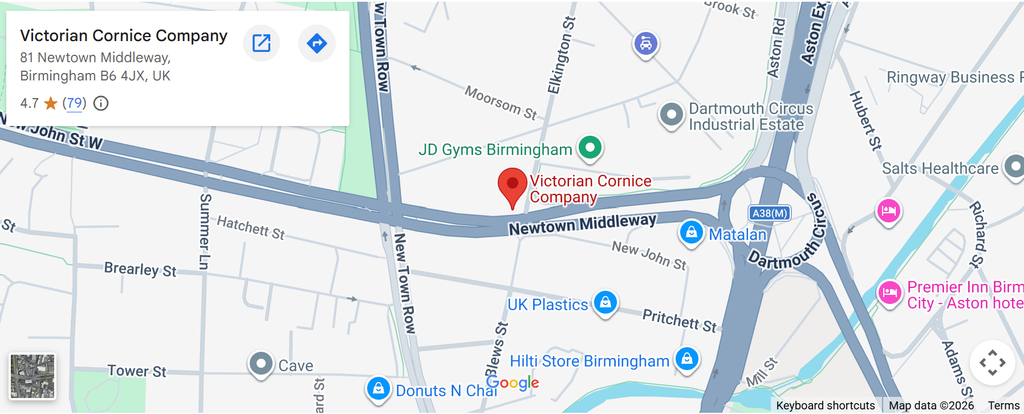
At Victorian Cornice Company, our traditional plaster cornice and coving is handmade in our Birmingham workshop using traditional fibrous plaster techniques.
Our Edwardian range includes a wide selection of profiles, from simple ogee and stepped coving through to larger traditional cornice designs.
We can also reproduce existing plaster mouldings where an original section is available and manufacture bespoke plasterwork for restoration projects.
Our plaster cornice is available for nationwide supply, with professional installation available throughout the UK.